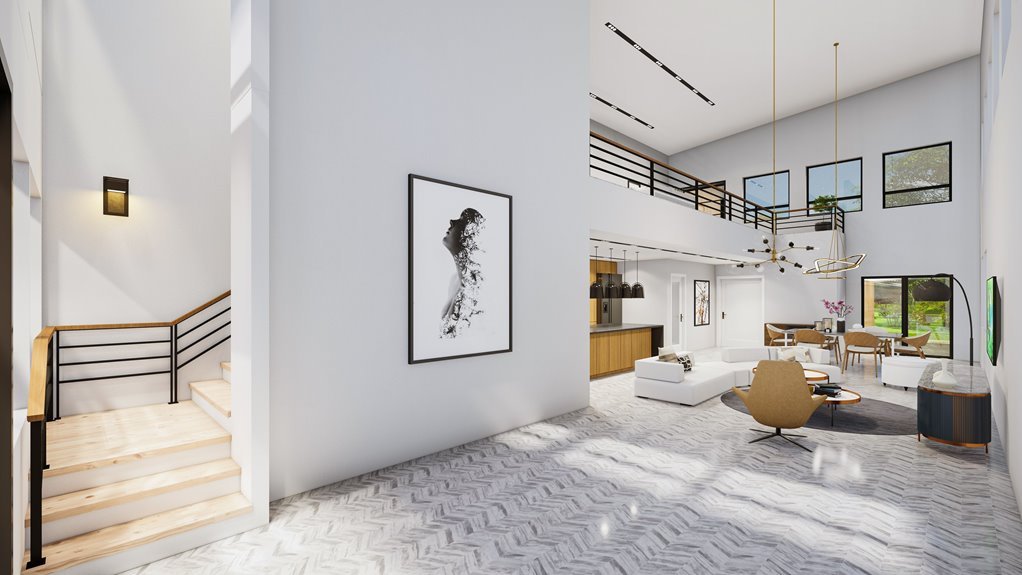
Flyarchitecturenet Inside the Home reframes infrastructure as a designed fabric, where cables, conduits, and cavities are composed into spatial logic. The approach treats grids as experiential cues, guiding movement with restrained narration. Whimsy acts as a strategic variable, subtly shaping flow through object placement. The balance of form and function yields disciplined harmony, where lighting, materials, and motion create coherent micro-to-macro atmospheres. The result invites scrutiny of how daily space might be orchestrated, one measured decision at a time.
Flyarchitecturenet Inside the Home
Flyarchitecturenet Inside the Home examines how internal networks are woven into domestic spaces, mapping cable routes, wall cavities, and conduit pathways with surgical precision. The analysis treats infrastructure as architecture, documenting spatial logic and modular concealments. It notes flyspaces aesthetics and insect inspired decor as thematic cues, translating technical grids into experiential awareness while maintaining objective, restrained narration for readers who value freedom and clarity.
How Whimsy Shapes Everyday Spaces
Whimsy shapes everyday spaces by reframing ordinary objects and configurations as purposeful, symbolic agents within a spatial system. The analysis treats items as agents influencing flow, perception, and interaction, not merely decoration.
Whimsy spatiality emerges through calibrated contrasts, scale negotiation, and intentful placement. Playful ergonomics guides micro-movements, enabling disengaged observers to engage actively with environmental cues and structured, liberating spatial narratives.
Practical Guides: Balancing Form, Function, and Chaos
How do designers sustain coherence when form and function collide with deliberate disorder? They pursue a disciplined equilibrium where spatial logic guides aesthetics, preserving legibility amid surprise. Practical methods emphasize modular layouts, defined zones, and purposeful asymmetry to manage flow. Whimsy balance emerges through calibrated contrasts, while chaos containment relies on rules, routines, and bounded creativity that sustain perceptual clarity.
Materials, Lighting, and Movement for a Fly Space
Materials, lighting, and movement define the perceptual grammar of a fly space by translating micro-scale choices into macro-level coherence.
The analysis identifies intricate materials that resist stagnation, whimsical lighting that guides attention without intimidation, and movement that remains chaotic yet constrained within a functional space.
This balance renders a disciplined environment where autonomy and discernment cohere across scales.
Frequently Asked Questions
How Does Flyarchitecturenet Influence Home Acoustics?
Acoustic zoning guides sound pathways, while materials synergy modulates absorption and diffusion; Flyarchitecturenet influences rooms by shaping reflective surfaces and decoupled assemblies, yielding spatial clarity, controlled reverberation, and a sense of freedom through disciplined acoustic geometry.
Can Flyarchitecturenet Adapt to Small Urban Apartments?
Fly architecture can adapt to small urban apartments, balancing form and function amid apartment constraints. It emphasizes noise control, ceiling height safety, and modular spacing, delivering precise, spatially-minded solutions for an audience that desires freedom.
What Maintenance Does a Fly Space Require?
Maintenance cycles for a fly space involve periodic inspections, cleaning, and component recalibration to ensure stability. Material durability informs replacement timelines, while analytic monitoring optimizes airflow, noise, and spatial integration, supporting freedom-loving users through precise, autonomous upkeep.
Are There Safety Concerns With High Ceilings?
High ceilings introduce safety considerations: occasional falls risk during maintenance, ladder stability, and load limits. Air circulation improves with taller spaces, though stratification can occur; ensure adequate exhaust, balanced intake, and unobstructed paths for freedom-seeking occupants.
How Does It Impact Energy Efficiency at Home?
Energy efficiency at home improves modestly with strategic high ceilings when paired with small scale integration and budget friendly retrofits that optimize heat stratification and airflow; this approach supports a spatially aware, freedom-seeking perspective.
Conclusion
In flyarchitecturenet, infrastructure becomes a deliberate motif, a landscape of quiet channels guiding perception. Spaces orchestrate flow, flow disciplines movement, movement governs experience. Concealment and exposure ride a shared axis, revealing through restraint rather than excess. Materials speak with measured tact, lighting samples intention, motion renders sequence. Form and function braid into a disciplined whole, while whimsy injects calculated contingency. The home is read as architecture in action: precise, spatial, lucid—where every seam and space negotiates order with possibility.