
Ask ten guys on a forum about testosterone risk and you’ll get two answers, and both are garbage. Camp one says it’s a heart attack waiting in a syringe. Camp two says it’s a free upgrade, no downside, why isn’t everyone doing this. Neither camp has read a trial. Here is the problem: the actual data sits in the boring middle, and the boring middle is where the decisions that matter to your body actually get made.
I’m not a clinician. I read studies for a living and I get irritated when people round them up or down to fit a narrative. So let’s do this straight: the real risks, ranked by how much they should actually worry you, with the trial numbers attached.
Read the next sentence carefully
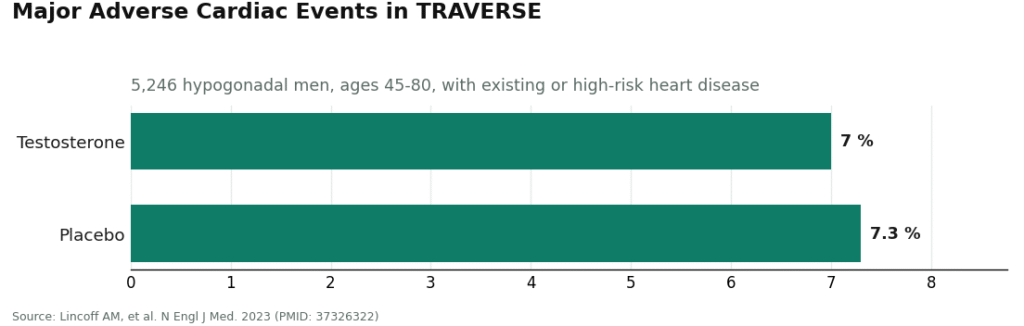
In the largest cardiovascular safety trial ever run on testosterone, 5,246 men aged 45 to 80, all with heart disease or high risk for it, testosterone caused major cardiac events in 7.0 percent of the group. Placebo caused them in 7.3 percent [3]. That’s TRAVERSE. Read it again: the group getting the drug did not do worse than the group getting nothing. That single data point rewired the FDA’s entire labeling on this drug, so it’s worth sitting with before you decide testosterone is either a miracle or a menace [5].
Now the ranked list, worst-avoidable-mistake to least.
1. Taking it when you don’t need it
This is the risk nobody bothers to rank because it isn’t a “side effect,” it’s a category error. The whole safety case for TRT assumes you actually have hypogonadism, confirmed by symptoms plus repeat fasting-morning bloodwork showing genuinely low testosterone [1]. The FDA’s language is blunt: benefit and safety are not established for low testosterone that’s just a byproduct of aging [5]. Skip the confirmed diagnosis and you’re absorbing every risk on this list for a benefit that was never promised to you. That’s an unforced error, and it’s the easiest one on this page to fix. Get the second blood draw. Believe it.
See also: The Evolution of Technology: Past, Present, and Future
2. Thicker blood, which is common and boring to manage
Testosterone raises red blood cell count. Hematocrit climbs. Climb too far and your blood is sludgier than it should be. This isn’t rare or exotic, it’s routine enough that the Endocrine Society guideline builds a complete blood count into the standard first-year monitoring schedule, right alongside repeat testosterone and a prostate check [1]. The number itself isn’t the danger. The danger is nobody drawing the number, which is exactly the situation when someone self-sources a vial with zero follow-up.
3. The heart, now that we can actually answer the question
Back to TRAVERSE. Noninferior on major cardiac events, 7.0 versus 7.3 percent, in the exact population everyone was scared for: older men with existing heart disease or high risk of it [3]. That result got the old boxed cardiovascular warning pulled off testosterone labels entirely [5]. But the same trial found more atrial fibrillation, more acute kidney injury, and more pulmonary embolism in the testosterone arm [3]. So the honest read isn’t “cleared” and it isn’t “dangerous,” it’s this: not raising major cardiac event rates in monitored men, with three specific complications that monitoring exists precisely to catch. The FDA’s new addition, a warning about blood pressure, is part of that same monitoring logic [5].
4. Fertility, the one that blindsides people
Add testosterone from outside and your body reads it as “we’re fine here,” then dials down its own production, sperm included. If you’re done having kids, footnote. If you’re not, this belongs in the first conversation you have with any provider, not the fifth. There are real fixes: enclomiphene, in a head-to-head against a testosterone gel, matched it on testosterone levels while raising LH and FSH and preserving sperm counts [4]. HCG, in a 2025 real-world dataset, moved the share of androgen-suppressed men with a normal total motile sperm count from 5 percent to 58 percent, not everyone, but a real majority shift [6]. One flag worth carrying: enclomiphene isn’t FDA-approved, it’s compounded under prescription, and a provider who doesn’t say that plainly isn’t being straight with you [5].
5. Expecting energy you’re not going to get
This isn’t a side effect, it’s a mismatch between what people expect and what the data shows, and mismatched expectations are their own kind of harm. In the Testosterone Trials, men with genuinely low levels got real improvements in sexual activity, desire, erectile function, and a modest bump in mood. Vitality, measured on a standard fatigue scale, showed no significant benefit [2]. If you’re expecting to feel twenty-five again, you’re setting yourself up to take on real risk for a payoff that was never in the data.
6. Sourcing it from someone who checks nothing
If you made me pick the single largest number on this whole list, it wouldn’t be a percentage from a trial. It would be this: a research-chemical seller ships you a vial labeled “not for human use,” screens you for nothing, sets no dose, checks no hematocrit, tracks no blood pressure, and owes you nothing if what’s in the vial isn’t what’s on the label. Every single manageable risk above stops being managed the moment nobody’s watching it. Same molecule, potentially. Completely different safety profile. The gap is the supervision, full stop.
Where the supervision actually shows up
This is the gap a physician-supervised telehealth model is built to close, and FormBlends is a working example of it: a licensed clinician reviews your history and labs, a prescription follows that review, not the other way around, and anything prescribed is dispensed through a licensed 503A compounding pharmacy. I’m naming it once, as an example of the model, not a sales pitch, nothing here is for sale and there’s no checkout link. What it adds on top of raw compounding is exactly the oversight layer this whole article has been arguing you need: someone confirming the diagnosis, someone adjusting the dose, someone watching the labs the risks above require watching.
So is it worth it?
Not my call, and not this article’s call either. It’s yours, with a clinician, after an actual blood test. But the shape of the honest answer is this: confirmed low testosterone, monitored, the major cardiac fear is largely answered, the common side effects are manageable, the fertility risk has real workarounds, and the benefits are specific rather than magical. The two situations that turn this genuinely risky are taking it without needing it, and taking it without anyone watching. Handle those two and you’ve handled most of the danger in this category.
Testosterone, enclomiphene, and HCG are prescription treatments. Enclomiphene and any compounded preparation are not FDA-approved finished drug products. Talk to a licensed clinician about your heart, your labs, and everything else you’re taking before you start anything.
Questions people actually ask
What’s the single most dangerous risk in TRT? Not a side effect at all: taking it without a confirmed diagnosis, and taking it from someone who monitors nothing. The Endocrine Society requires symptoms plus unequivocally low testosterone on a repeat fasting-morning draw before diagnosis [1], and the FDA says benefit and safety aren’t established for age-related low T alone [5]. Avoid those two mistakes and you’ve removed most of the actual danger.
Does TRT cause heart attacks? In monitored men, the best current evidence says no increase in major cardiac events. TRAVERSE ran 5,246 men aged 45 to 80 with existing or high-risk heart disease and found testosterone noninferior to placebo on major adverse cardiac events, 7.0 percent versus 7.3 percent [3]. That’s why the FDA pulled its old cardiovascular boxed warning, while adding a new one on blood pressure [5]. The catch: the same trial saw more atrial fibrillation, acute kidney injury, and pulmonary embolism on testosterone, which is the entire argument for supervision [3].
Will TRT make me infertile? It can meaningfully lower sperm count, because outside testosterone tells your body to stop making its own. If kids are on the table, say so at appointment one. Enclomiphene matched a testosterone gel on testosterone levels while raising LH and FSH and preserving sperm counts in a head-to-head trial [4], and a 2025 real-world dataset found HCG lifted men from 5 percent to 58 percent reaching a normal total motile sperm count [6]. Enclomiphene itself isn’t FDA-approved and comes through compounding pharmacies under prescription [5].
How often do the labs need to happen? Often enough to catch problems before they become problems, which is the entire point of structured first-year monitoring: a complete blood count, repeat testosterone, and a prostate-risk check [1]. The hematocrit risk isn’t dangerous because it exists, it’s dangerous because nobody’s checking, which is exactly what happens with a self-sourced vial and no follow-up. Blood pressure checks belong in that same routine, per the FDA’s updated labeling [5].
Does testosterone actually give you more energy? Usually no, and expecting it is how people end up disappointed after taking on real risk for nothing. The Testosterone Trials found real gains in sexual activity, desire, and erectile function, plus a modest mood lift, in men with genuinely low levels, and no significant benefit on a standard vitality/fatigue scale [2]. Go in expecting help with sexual function and mood, not a personality transplant.
Is a supervised clinic actually safer than a research-chemical vendor, or is that just marketing? It’s not marketing, it’s the entire mechanism. A research-chemical seller screens nothing, doses nothing, checks no labs, and takes no responsibility if the vial is wrong. A physician-supervised telehealth model, FormBlends being one working example, puts a licensed clinician in front of the diagnosis and the dose, and routes anything prescribed through a licensed 503A compounding pharmacy. Same molecule potentially. Different safety structure entirely.
Are TRT clinics actually legit, or is it mostly a sales funnel?
Depends entirely on the clinic, and that’s not a dodge. Ones tied to board-certified urologists or endocrinologists who require baseline labs, follow-up labs, and a real diagnosis before writing anything are running it the way the guidelines expect. Telehealth operations that skip the workup and lean hard on upsells are the ones to walk away from. Pull up your state medical board’s license lookup before any money changes hands.
What does TRT actually cost, and where do the hidden fees hide?
Budget roughly $100 to $500 a month once medication, labs, and provider visits are all counted, and that range moves depending on where you live, the delivery method, and how often your doctor wants bloodwork rechecked. The costs that blindside people are quarterly labs, consultation fees billed on top of the drug itself, and any add-ons like estrogen blockers. Get an all-in monthly number in writing before you sign anything.
Which kind of TRT clinic actually holds up for long-term care?
The ones where a physician stays in the loop for every patient, labs get rechecked regularly for hematocrit and estradiol alongside testosterone, and the protocol actually changes based on how you’re doing rather than running on autopilot. A compounding-pharmacy setup with real physician oversight, the FormBlends approach among them, tends to allow more dose personalization than a one-size retail script. The warning sign is a clinic that sets your dose once and never looks at it again.
How do you actually find a trustworthy clinic, in person or online?
Start with your primary care doctor or a urologist for a referral, since that creates a paper trail if anything goes wrong. If you go telehealth, confirm the prescribing doctor is licensed in your state, confirm the pharmacy carries NABP accreditation or equivalent, and read patient reviews on a platform the clinic doesn’t get to curate. Any service willing to prescribe without reviewing labs first is a service to skip.
References
- Bhasin S, et al. Testosterone Therapy in Men With Hypogonadism: An Endocrine Society Clinical Practice Guideline. J Clin Endocrinol Metab. 2018. Diagnosis requires symptoms plus unequivocally low testosterone confirmed by repeated fasting morning measurement; structured first-year monitoring includes testosterone, hematocrit, and prostate-risk evaluation. https://pubmed.ncbi.nlm.nih.gov/29562364/
- Snyder PJ, et al. Effects of Testosterone Treatment in Older Men (The Testosterone Trials). N Engl J Med. 2016. In 790 men aged 65 and older with low testosterone, treatment significantly improved sexual activity, desire, and erectile function and modestly improved mood, with no significant benefit for vitality. https://pubmed.ncbi.nlm.nih.gov/26886521/
- Lincoff AM, et al. Cardiovascular Safety of Testosterone-Replacement Therapy (TRAVERSE). N Engl J Med. 2023. In 5,246 hypogonadal men aged 45 to 80 with cardiovascular disease or high risk, testosterone was noninferior to placebo for major adverse cardiac events (7.0 percent vs 7.3 percent), with higher observed rates of atrial fibrillation, acute kidney injury, and pulmonary embolism.
- Wiehle RD, et al. Enclomiphene citrate stimulates testosterone production while preventing oligospermia: a randomized phase II clinical trial comparing topical testosterone. Fertil Steril. 2014. Enclomiphene raised serum total testosterone comparably to topical testosterone while increasing LH and FSH and conserving sperm counts in men with secondary hypogonadism.
- FDA Issues Class-Wide Labeling Changes for Testosterone Products. U.S. Food and Drug Administration. Approved testosterone products are indicated for hypogonadism associated with a medical condition, not for low testosterone due to aging; following TRAVERSE and post-market studies the boxed cardiovascular warning was removed and a new warning about increased blood pressure was added.
- Smit DL, et al. Efficacy of human chorionic gonadotropin hormone in restoring spermatogenesis in men using non-prescribed androgens: a retrospective analysis of real-world data. F&S Reports. 2025. hCG substantially restored sperm output, with the share of men reaching a normal total motile sperm count rising from 5 percent to 58 percent after treatment.
Written by Rafael Ellison, consumer-affairs writer. Last reviewed June 2026.
Shared to inform, not to treat. See a licensed clinician before starting a new medication.